A woman walks through mud and debris left behind by flash flooding in Nepal’s Nuwakot district, as the death toll from the disaster climbs past 800 with thousands still missing.


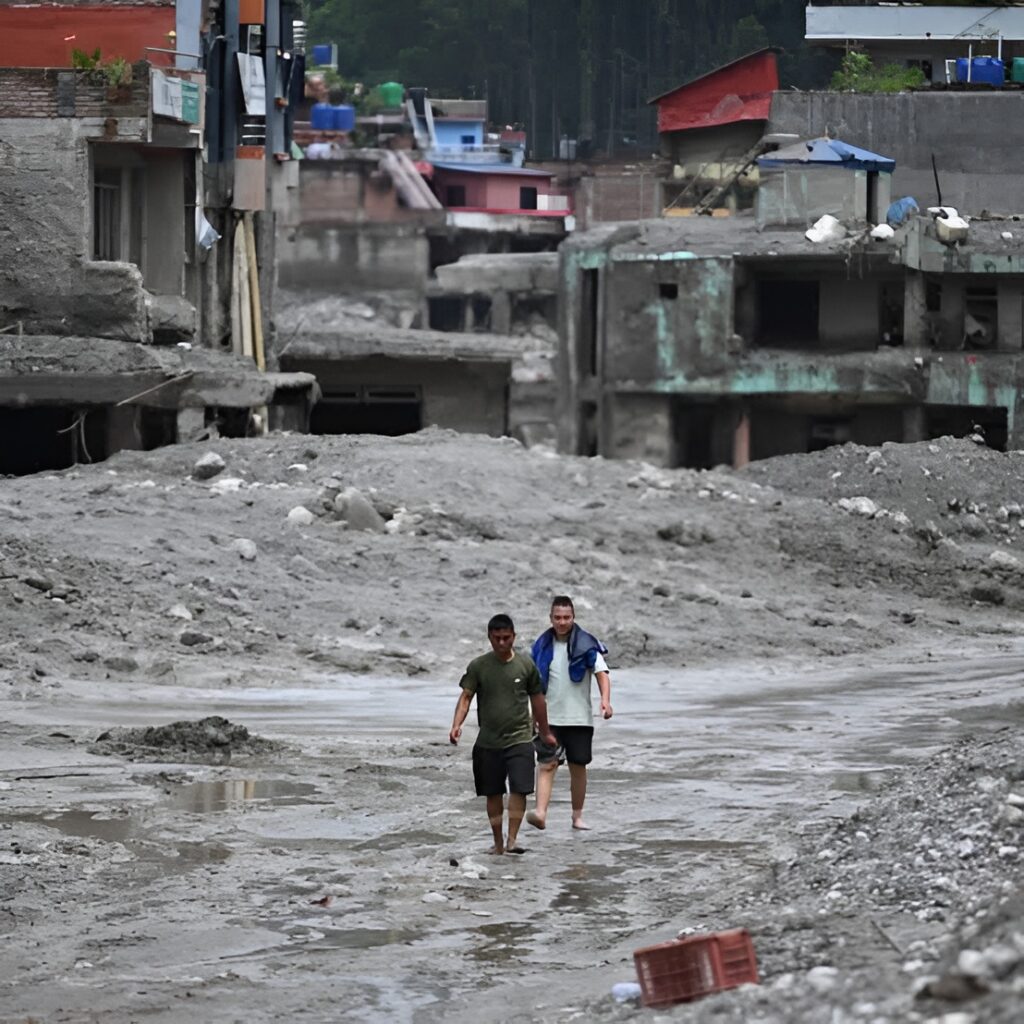
A woman walks through mud and debris left behind by flash flooding in Nepal’s Nuwakot district, as the death toll from the disaster climbs past 800 with thousands still missing.
The death toll from last week’s catastrophic flash flooding along the Nepal-China border has risen to 800, with around 3,000 people still missing, as rescue operations entered their fourth day amid worsening weather conditions that continue to hamper search efforts across the disaster zone.
Nepalese Foreign Minister Shisir Khanal said locating those still missing is “currently our national priority,” as families gathered at relief centers and outside Kathmandu’s main government hospital, scouring paper lists and waiting anxiously for any news of loved ones. Many have traveled from outlying districts to the capital in search of information, camping outside hospital gates for hours at a time as officials work through an overwhelming volume of inquiries. The disaster was triggered on Wednesday, August 26, when bedrock underneath a glacier near the Langtang Lirung peak in the Himalayas collapsed, taking a large section of the glacier down with it. The rockfall was so severe it registered as a magnitude 5.2 seismic event, a scale more commonly associated with a moderate earthquake than a glacial event, underscoring the sheer force involved in the initial collapse. Jakob Steiner, a geoscientist at the University of Graz in Austria who is currently based in Bangladesh, described the event plainly, saying “a lower part of a glacier has really come off.” The resulting avalanche of ice, pulverized rock and meltwater swept downstream, swelling rivers in the valleys below and taking just six to seven minutes to reach Gyirong Port on the Chinese side of the border, according to Chinese officials, before continuing its destructive path through Nepal.
Also Read: 3 Dead in Twin Falls In-N-Out Shooting, Bystander and Off-Duty Trooper Credited With Stopping Gunman
The flooding destroyed bridges, homes and critical infrastructure across the region, with buildings and roads swept away in both Tibet and Nepal. Satellite imagery comparing the Langtang Lirung valley on June 25, 2026, to images taken on August 26, the day of the disaster, shows a dramatic transformation of the terrain, with entire sections of the glacier and surrounding landscape visibly altered in the span of just two months. A barrier lake that formed near the flood zone following the initial landslide has since overflowed and begun discharging water, Chinese officials said Sunday during a news conference broadcast on state media. “The barrier lake has already overflowed and started to discharge water,” officials said at a regional press briefing in Tibet, adding that the overall situation is now considered stable and that the possibility of a complete breach is “relatively low.” That assessment offered some measure of relief to a disaster response effort that has otherwise been marked by grim and slow-moving progress over the past several days, with rescue teams working under difficult and often dangerous conditions as they navigate unstable terrain still prone to further collapse.
Among the most closely watched rescue efforts has centered on the Trishuli-3 “A” Hydropower Project, where a tunnel was buried under thick mud and sludge during the flooding, trapping an unknown number of workers who had been on site at the time. Nepal’s Minister of Energy, Water Resources and Irrigation, Biraj Bhakta Shrestha, wrote in a Saturday night update that crews working with excavators had drilled a six-inch hole through the tunnel’s upper section, a painstaking process complicated by the volume of debris and the risk of further collapse inside the structure. Initial inspections through the opening showed no visible debris inside, and rescue teams have since pumped air into the tunnel and let in light and sound in an effort to reach anyone who may be trapped, though they have not yet been able to establish communication with survivors. “The plan is now to enlarge the existing hole and create a manhole so that the rescue operation can proceed further,” Shrestha wrote, describing the delicate, painstaking nature of the ongoing effort, one that has drawn intense public attention given the uncertainty over how many people remain inside and their condition after several days without contact. Rescue operations across the broader region were reported to have paused overnight following a day of frantic search efforts, before resuming again with the arrival of daylight, a pattern that has repeated itself over the past several nights as crews balance the urgency of the search against the safety risks of operating in the dark across unstable ground.
The scale of those affected extends well beyond Nepal’s borders. More than 700 foreigners, including dozens of Americans, are among those still unaccounted for, according to earlier reporting on the disaster, reflecting Nepal’s status as a major destination for trekkers, students and workers from around the world, many of whom were in the affected region at the height of the trekking and internship season. Among the missing are three Kathmandu University students who had been completing an internship at the Upper Trishuli 3B Hydropower Project and remain unreachable, according to the university, a detail that has drawn particular concern from the broader academic community given the students’ ages and the circumstances of their disappearance. For Nepalis living abroad, the disaster has meant an anxious, distant vigil, with many describing a persistent sense of helplessness at being unable to do more than monitor updates from afar. One student, whose family in Kathmandu remains safe, described checking constantly for updates even while trying to continue her studies overseas. “It’s honestly very unsettling to be away from home,” she said. “Even in between my assignments here, I find myself making time to check what is happening back home and checking in with my parents to make sure everything is normal.” She added, “It’s really sad to see people in my country being affected,” a sentiment echoed widely across the Nepali diaspora in the days since the disaster struck.
Given the scale of the disaster, Nepal’s government has formally requested specialized international assistance, including support for tunnel rescue operations, survivor-detection technology, rapid forensic and DNA analysis capabilities, and additional morgue refrigeration to handle the mounting number of casualties, a request that reflects both the scale of the tragedy and the limits of Nepal’s existing disaster response infrastructure when confronted with an event of this magnitude. An 11-member tunnel rescue reconnaissance team from India has already been deployed to assist local crews, Khanal said, while a similar team from China is expected to arrive shortly to help coordinate cross-border recovery efforts, given that the disaster’s origin point and immediate impact zone span both sides of the Nepal-China border.
Also Read: Amazon Just Laid Off the People Building Its AI. That Should Terrify Every White-Collar Worker
The disaster marks one of the deadliest flooding events in Nepal’s recent history, surpassing the death tolls recorded during major flood years in 2020 and 2024, both of which were driven primarily by monsoon rainfall rather than a sudden glacial collapse. The 2020 floods, concentrated largely in western Nepal’s Myagdi District, claimed roughly 400 lives, while the 2024 floods, which struck the country’s eastern and south-eastern districts across three separate waves through the monsoon season, killed more than 300 people and caused billions of rupees in property damage. This year’s disaster has already far exceeded both in scale within just days of striking, a comparison that has intensified public and scientific scrutiny of the specific glacial mechanisms behind the collapse. Scientists have pointed to the event as a stark illustration of the growing instability of Himalayan glaciers amid a warming climate, with researchers noting that glacial collapses of this scale, while historically rare, may become an increasingly significant hazard across the region as rising temperatures continue to destabilize high-altitude ice formations that have remained largely intact for centuries.
As rescue operations continue into their fifth day, officials have cautioned that the death toll and number of missing are likely to continue shifting as search teams gain further access to the hardest-hit and most remote areas of the disaster zone, some of which remain difficult to reach even under normal conditions given the region’s mountainous terrain. With international rescue teams now arriving to support the effort, attention in the coming days is expected to remain focused on the fate of those still trapped, particularly at the Trishuli hydropower tunnel, even as the broader humanitarian response shifts toward supporting the tens of thousands of people displaced or otherwise affected across the flood-stricken region.


Nana Patekar, the veteran actor whose career spanned nearly five decades, died on Thursday at the age of 75.

The Irkutsk Anti-Plague Research Institute, where a laboratory technician died this month, prompting quarantine measures and fears of pneumonic plague.

President Trump has approved the execution by firing squad of Nidal Hasan, the former Army major convicted of killing 13 people in the 2009 Fort Hood shooting.

Taylor Swift became the most-awarded artist in VMA history at the 2026 ceremony, dedicating her Video of the Year win to the late Dolly Parton.