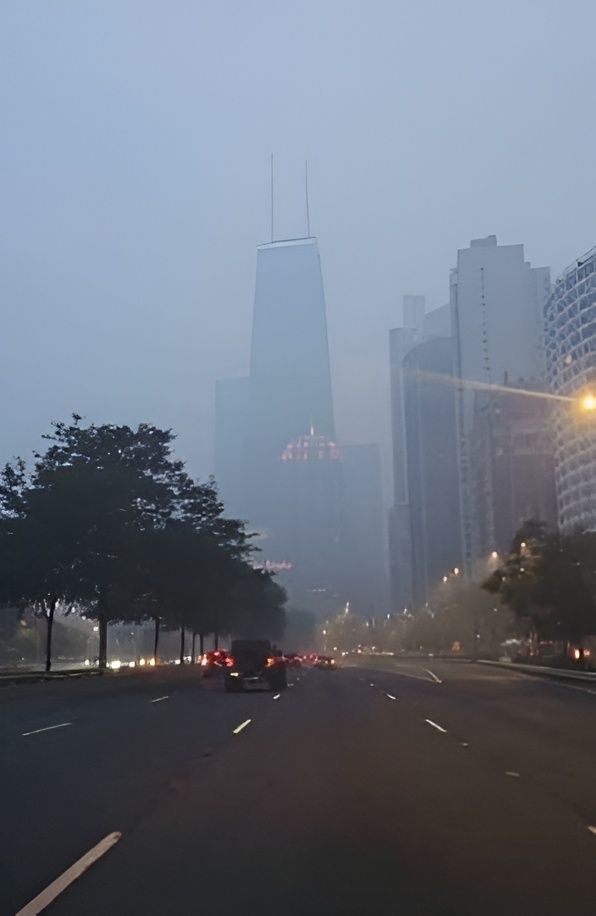
Chicago air quality plunged to some of the worst levels of any major city on Earth this week as thick smoke from Canadian wildfires settled over the Midwest, triggering health warnings from Minneapolis to Boston and leaving millions of Americans wondering when clearer skies might return. At various points on Thursday, Chicago ranked among the top three worst cities in the world for air pollution, trading the unwanted distinction back and forth with Detroit, Minneapolis and New York as the smoke rolled through the region.
The Illinois Environmental Protection Agency declared Thursday a Red Forecast Air Pollution Action Day, warning that conditions had grown so unhealthy that they posed a risk to everyone, not just people with existing health conditions. Officials said the poor air could stretch into Friday as well. Older adults, children and people with weakened immune systems were flagged as especially vulnerable, with symptoms ranging from asthma attacks and chest pain to headaches, fatigue and difficulty breathing. The Chicago Park District moved all of its day camps indoors, and residents who ventured outside described feeling the smoke in their throats within minutes.
The source of the haze is a combination of massive wildfires burning across Canada, along with additional fires burning in northern Minnesota. A stubborn high pressure system parked over the Great Lakes has trapped that smoke close to the ground rather than letting it disperse into the upper atmosphere, according to National Weather Service meteorologists tracking the event. That is a different pattern than earlier in the week, when a separate smoke plume stayed higher up and caused less severe ground level impacts. This latest wave sank to the surface, which is why air quality readings deteriorated so sharply across the Northeast, the Great Lakes and the Midwest all at once.
Also Read: Cyclosporiasis Outbreak Spreads Across 31 States, Federal Health Officials Say
CNN reported that the smoke has brought dangerous air quality to more than 120 million people across the Midwest and Northeast, with alerts stretching from Boston to Minneapolis. Cities closest to the source of the fires, including Chicago, Detroit and Toronto, saw air quality index readings climb well past the hazardous threshold. Forecasters expect the smoky conditions to persist through Saturday as new plumes continue drifting south from Canada, even as this particular round is expected to ease somewhat once winds shift out of the northwest later in the week.
That shift will not necessarily mean the problem is over. National Weather Service meteorologist Jake Petr said the region should not expect a permanent fix simply because one round of smoke clears out. As long as the fires keep burning north of the border, any weather pattern that funnels air from that direction has the potential to send smoke back into the Midwest. Officials have cautioned that a lasting resolution may not come until the fires themselves are extinguished, something that in past wildfire seasons has not happened until the onset of winter snow in Canada and northern Minnesota.
The government air quality alert covering the Chicago area is set to remain in effect through midnight Friday, according to the National Weather Service. Chicago Sun-Times reporting noted that at different points Thursday, Chicago ranked between first and third worst among the world’s largest cities for air pollution, based on rankings from a Swiss air quality technology company. Fine particulate matter, known as PM2.5, is the primary health concern tied to wildfire smoke because the particles are small enough to lodge deep in the lungs and enter the bloodstream, raising the risk of heart attacks and strokes with prolonged exposure.
Also Read: At Least 27 Dead After Fire Tears Through Bangkok Pub
Chicago is far from alone. Air quality alerts have been issued across a wide swath of the country this week, covering Michigan, Wisconsin, Minnesota, Pennsylvania, and parts of New York and New England. In Detroit, air quality was measured at hazardous levels, and photos from the city showed the skyline nearly obscured by haze. Wisconsin’s Department of Natural Resources issued its own advisory as the smoke pushed south from Minnesota and Canada. Meanwhile, wildfires burning in the western United States have already scorched more than 3.6 million acres this summer, adding to the smoke burden in some parts of the country even as the Canadian fires remain the dominant source of the current Midwest and Northeast air quality crisis.
For residents trying to track conditions in real time, tools like AirNow.gov and IQAir’s live maps have become go to resources, showing current AQI readings alongside forecasts for how conditions are expected to shift over the coming days. Health officials recommend that anyone in an affected area limit time outdoors, keep windows and doors closed, and consider wearing a well fitted mask if they need to be outside for extended periods, particularly if they fall into a sensitive group such as children, older adults, or those with asthma or other respiratory conditions.
The smoke’s reach extends well beyond the Midwest’s biggest cities. Smaller metro areas including Cleveland, Pittsburgh, Buffalo, and Rochester have also seen air quality warnings this week, and residents as far away as New Jersey, Connecticut, and Philadelphia have reported hazy skies and the distinct smell of burning wood drifting through their neighborhoods. That smell, along with reduced visibility, has become one of the clearest signs for people wondering why it suddenly looks and smells smoky outside even in areas hundreds of miles from the nearest active fire.
Canadian fire officials have not indicated any imminent end to the fire activity driving this pattern. Past wildfire seasons in Canada have burned tens of millions of acres and sent repeated waves of smoke into the United States over the course of an entire summer, and meteorologists are cautioning that this year could follow a similar trajectory. That means residents across the Midwest and Northeast may need to get used to checking air quality forecasts the same way they check the weather, since another shift in wind direction could send fresh smoke back into the region even after the current alert expires.
For now, the National Weather Service’s guidance is straightforward. If winds shift out of the northwest as expected later this week, air quality in Chicago and much of the Midwest should gradually improve heading into the weekend. But with fires still actively burning across a wide stretch of Canada, forecasters are stopping short of promising a lasting return to clean air, and they are urging residents to keep monitoring local alerts rather than assuming the worst has passed once skies look a little clearer.
Also Read: The LHC Doomsday Panic Says More About Us Than About CERN