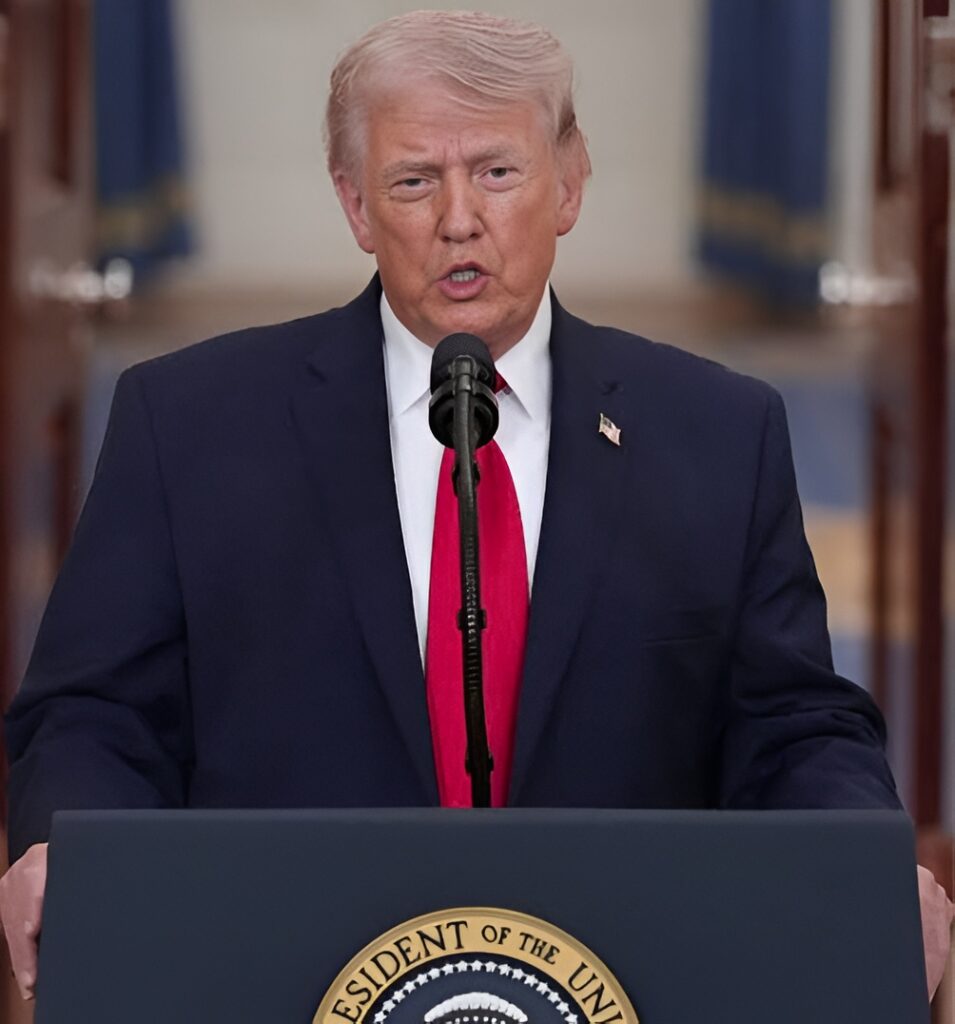
President Donald Trump’s speech tonight drew millions of viewers as he addressed the nation in a rare primetime broadcast from the East Room of the White House, using the moment to revive long-standing claims about the security of American elections. The address, which began at 9 p.m. Eastern on Thursday, had been teased for days by the president as “really, really big news,” and it ultimately centered on a batch of newly declassified intelligence documents that Trump said reveal serious vulnerabilities in the country’s voting infrastructure.
The 9 p.m. Eastern slot is one traditionally reserved for a president’s most consequential remarks, the kind of window historically used for Oval Office addresses and State of the Union speeches. That timing, paired with the administration’s insistence that Americans needed to tune in, fueled speculation for nearly a week about what exactly the president planned to announce. White House press secretary Karoline Leavitt previewed the speech earlier Thursday, telling reporters that the president was focused on the integrity of the nation’s elections and framing it as an issue that should unite both parties rather than divide them.
When the moment finally arrived, Trump opened by casting doubt on public confidence in the electoral system, arguing that the current setup falls short of what Americans deserve. He then announced that his administration would declassify a set of intelligence documents gathered by the White House Government Transparency Task Force, working alongside the President’s Intelligence Advisory Board and the heads of the nation’s top intelligence agencies. According to the president, those officials personally reviewed the findings and confirmed their authenticity before the speech aired. The documents, he said, would be published on a newly created government website beginning that night.
Also Read: A New Cold War Is Coming
Much of the substance of the address focused on the 2020 election, with Trump alleging that the declassified materials show evidence of Chinese efforts to influence that year’s presidential race, which he lost to Joe Biden. It marked yet another instance of the president revisiting a subject that has defined much of his political messaging since leaving office the first time, even though investigations by the intelligence community, the FBI, the Department of Homeland Security, the Department of Justice, and numerous bipartisan state election officials have repeatedly found no evidence that the 2020 results were altered through fraud or foreign manipulation. Independent audits, recounts, and court rulings across multiple states reached the same conclusion in the years following that election.
Democratic lawmakers moved quickly to respond. Senator Mark Warner issued a statement shortly after the address, arguing that the president was repeating claims that have been investigated for years and consistently rejected by the very agencies Trump cited during his remarks. Warner’s statement emphasized that the underlying facts about the 2020 election have not changed regardless of how many times the claims resurface.
Trump used the remainder of the address to renew his push for the Save America Act, legislation that would require proof of citizenship for voter registration and mandate identification at polling places nationwide. The bill has stalled repeatedly in Congress, lacking enough Republican support in the Senate to overcome Democratic opposition, and Thursday night’s speech did little to change the math on Capitol Hill. Still, the president urged lawmakers to act, framing the legislation as essential to restoring what he called free and fair elections ahead of the midterms later this year.
Reaction from within Trump’s own party was notably enthusiastic. Ohio Senator Bernie Moreno, a close ally of the president, said on social media that he had been briefed on the contents of the address ahead of time and encouraged Americans to watch. Moreno went so far as to compare the speech’s significance to President Kennedy’s 1962 address during the Cuban Missile Crisis, telling followers that the era of complacency toward China needed to end. That comparison drew immediate skepticism from commentators who noted the stark difference in stakes between a nuclear standoff and a set of declassified documents largely covering vulnerabilities that election security experts have discussed publicly for years.
Also Read: The Epstein Files Prove That Transparency Promised Is Not Transparency Delivered
The timing of Trump’s speech tonight was notable beyond the election integrity angle. It came amid renewed tensions with Iran, a midterm election cycle that could reshape the balance of power in Congress, two fatal shootings involving Immigration and Customs Enforcement agents, and the recent death of the president’s longtime ally, Senator Lindsey Graham. When radio host Hugh Hewitt asked Trump ahead of time what to expect, the president compared the upcoming remarks to speeches he had delivered earlier in July at Mount Rushmore and on the National Mall during celebrations marking the 250th anniversary of the Declaration of Independence, suggesting the tone would be consistent with his usual style rather than a wholly new format.
Cable news networks treated the address as a major event, with CNN, Fox News, and other outlets running extended live coverage and post-speech analysis well into the night. Fox News framed the president’s remarks around what it described as shocking vulnerabilities in election infrastructure, while CNN’s coverage noted that although the documents released Thursday were newly declassified, the vulnerabilities they describe have been publicly known and discussed by election officials for years. None of the newly released material, according to reporting from multiple outlets covering the address, demonstrated that any past election outcome, including the one in 2020, was actually changed as a result of foreign interference.
For viewers who missed the live broadcast, the speech is expected to remain available through White House channels and major news outlets that streamed it in full, including PBS, C-SPAN, and the cable news networks that covered it wall to wall. The new government website containing the declassified documents referenced during the address was live as of Thursday night, giving the public direct access to the material the president cited throughout his remarks.
Whether the speech shifts public opinion or moves the needle on the stalled Save America Act remains to be seen. What is clear is that the president’s decision to use a primetime address, a format typically reserved for moments of national urgency, ensured that his message reached a far larger audience than a standard press briefing or a series of social media posts would have. As the country heads deeper into a contentious midterm cycle, tonight’s remarks are likely to keep election integrity, and the broader debate over how much of the president’s claims hold up to scrutiny, at the center of the political conversation for days to come.
Also Read: Sen. Lindsey Graham Dies at 71 From Aortic Dissection, Tributes Pour In From Trump, Zelenskyy