Democrats won control of both the House and Senate on Tuesday, flipping seven Republican-held Senate seats and five governorships in a midterm election seen as a rebuke of President Trump’s agenda.


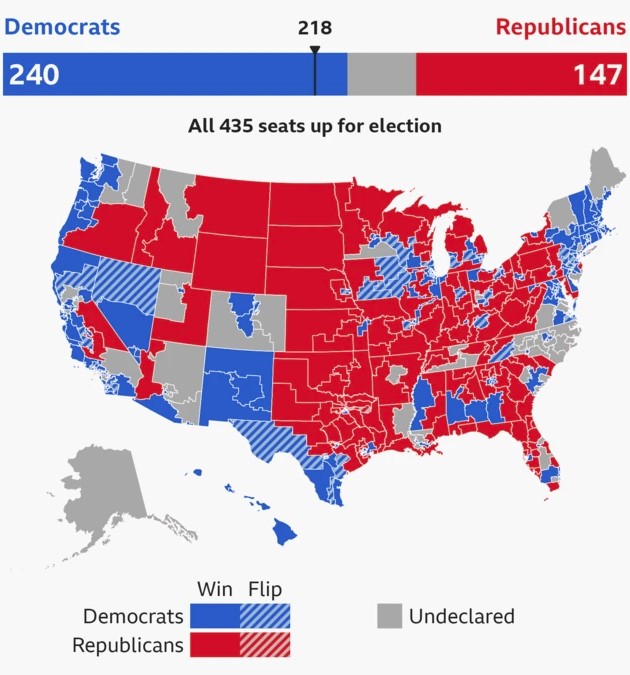
Democrats won control of both the House and Senate on Tuesday, flipping seven Republican-held Senate seats and five governorships in a midterm election seen as a rebuke of President Trump’s agenda.
Democrats won control of both the House of Representatives and the Senate in Tuesday’s midterm elections, flipping seven Republican-held Senate seats and five governorships in a result that shifts the balance of power in Washington for the final two years of President Donald Trump’s term.
It is the first time since 2006 that the minority party has taken control of both chambers in a single night, according to NBC News. The Associated Press called the House for Democrats early on Wednesday, and Democrats secured enough Senate seats to take control. Many races were still being counted on Thursday, and two Senate contests had not been called.
The House. Democrats are projected to win at least 250 of the 435 seats, according to CNBC and MS NOW estimates, against at least 160 to 165 for Republicans. Before the election, Republicans held 218 seats to the Democrats’ 214, and Democrats needed a net gain of only three seats. House Democratic leader Hakeem Jeffries said he expects Democrats to reach 255 seats or more, calling the result “an American tsunami.” Dozens of races remained uncalled on Wednesday.
The Senate. Democrats flipped Republican-held seats in Kansas, Iowa, Texas, Ohio, Maine, North Carolina and South Carolina, according to AP projections, erasing the Republicans’ 53-47 majority. Among the most notable results, James Talarico won a Texas Senate seat that Democrats had not held since 1988. In Maine, Democrat Troy Jackson was projected to defeat veteran Republican Senator Susan Collins. In North Carolina, former Governor Roy Cooper won the open seat, the first Democratic Senate win there since 2008. Democrats also held seats in Georgia, New Hampshire, Michigan and Minnesota. In Mississippi, Democrat Scott Colom was leading Republican Senator Cindy Hyde-Smith by only several dozen votes, and the race was rated a toss-up. Alaska, where Democrat Mary Peltola challenged Senator Dan Sullivan, had not been called.
Also Read: US Midterms 2026: When Will We Know the Results, and What Is at Stake?
Governors and legislatures. Democrats flipped five Republican-held governorships, in Texas, Georgia, Ohio, Iowa and Nevada, giving the party a majority of the nation’s governors for the first time since 2010, according to CNBC. The Texas result was described as a stunning upset. Democratic incumbents in Pennsylvania, Maryland and Illinois, Josh Shapiro, Wes Moore and J.B. Pritzker, also won. The wave extended to state legislatures, with Democrats flipping as many as 12 chambers, including the Texas House for the first time in more than two decades, both chambers in Wisconsin and the North Carolina House.
Why Democrats won, according to analysts. Political analysts largely attributed the result to voter dissatisfaction with the war with Iran that the Trump administration began, rising gas prices and broader economic anxiety, according to reporting by Northeastern University. NBC News said voters delivered a clear message that Congress had not done enough to provide checks on the administration and needed to address affordability and corruption. Senate Democratic leader Chuck Schumer, who is expected to return as majority leader, said the high cost of living and “Trump’s corruption” were at the forefront of voters’ concerns. Trump had urged voters to behave as if he were on the ballot.
Republican reaction. Republicans began assessing the losses on Wednesday. Florida Governor Ron DeSantis described the night as “close to an extinction-level event for Republicans,” according to Yahoo News. Vice President JD Vance blamed the Iran war for the losses, a statement that Trump later called “largely true.” Speaker Mike Johnson is not running for House minority leader, sources told ABC News, and Jeffries has officially launched his bid to become speaker, which would make him the first Black speaker if elected.
What changes in Washington. The new Democratic majorities will gain subpoena power through congressional committees and greater leverage over federal spending, according to MS NOW. Their ability to pass legislation will be limited by Trump’s veto, which he has said he plans to use, and by the Senate filibuster, which requires 60 votes for most bills. Jeffries and Schumer are planning an aggressive legislative and investigative agenda, CNN reported, and Democrats have said they will focus on affordability. A lame-duck session is also ahead, in which the outgoing Republican majorities may try to pass measures before the new Congress takes office on January 3.
Also Read: Israel’s Election Ends Without a Clear Winner as Netanyahu’s Bloc Falls Short of a Majority
Trump acknowledged the results and was reported to have said he would accept them, which helped calm Wall Street. Stocks rallied on Wednesday, though shares of companies tied to artificial intelligence and data centers fell after Democrats won in several key data center hubs. At the time of writing, neither Jeffries nor Schumer had heard directly from Trump, they said.
The scale of the victory will shape the next two years. For Democrats, it brings both power and pressure to deliver on affordability. For Republicans, it opens a debate over the Iran war, the party’s direction and the president’s influence. Final counts in Mississippi, Alaska and dozens of House races will determine just how large the Democratic majorities are, but the direction of the result is already clear.

Democrats won control of both the House and Senate on Tuesday, flipping seven Republican-held Senate seats and five governorships in a midterm election seen as a rebuke of President Trump’s agenda.

Binance, the world’s largest cryptocurrency exchange, says hackers used a fake job interview and an internal AI tool to steal about $6.3 billion in a record crypto heist.

Cargo ships lie at anchor in the Strait of Hormuz off Bandar Abbas, Iran, on October 24. The US carried out limited strikes on nearby Qeshm Island on Monday, officials said. (AP)

Congolese medical workers in protective equipment prepare to bury Dr Marie-France Shogogo, who died at an Ebola treatment centre after contracting the virus, in Bunia, Ituri province, on October 31. (Gradel Muyisa Mumbere/Reuters)