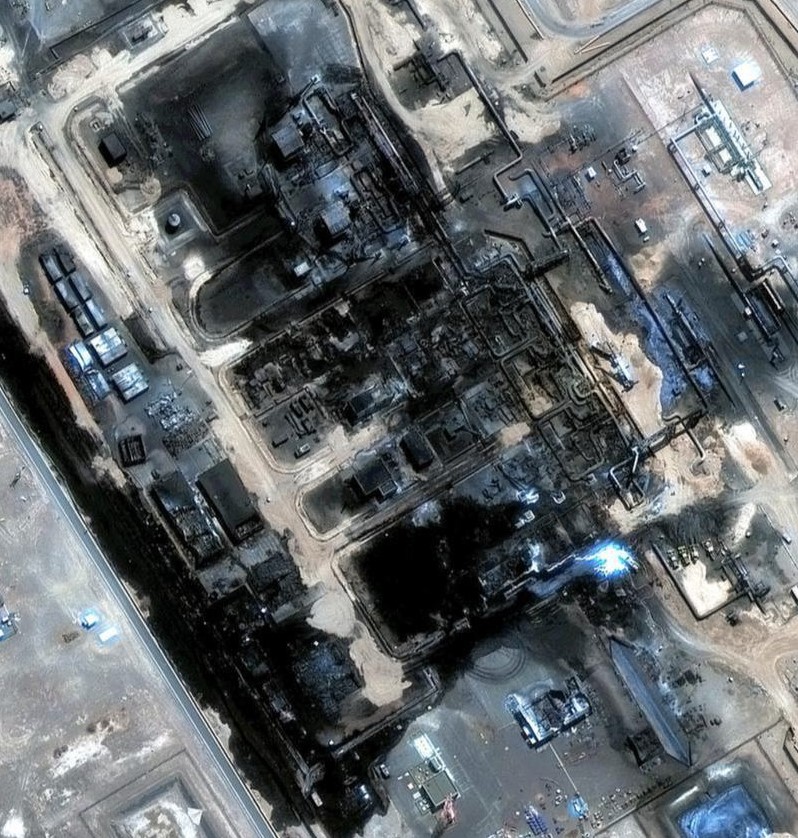
A drone attack struck a power distribution station in Medina, Saudi Arabia, early Tuesday, knocking a transformer supplying electricity to the Prophet’s Mosque out of service, in what the Saudi-led coalition says marks the second Houthi strike on the kingdom’s holy sites within two weeks.
Coalition spokesman Brigadier General Turki al-Maliki said the strike hit the Taibah power distribution station at approximately 5:11 a.m. local time on Tuesday, September 29. He said a technical examination of drone wreckage recovered at the scene confirmed Houthi involvement in planning and carrying out the attack on Saudi Arabian soil. According to al-Maliki, the facility supplies electricity to Al-Masjid an-Nabawi, the Prophet’s Mosque, one of the two holiest sites in Islam, though he said an alternative power supply system was activated following the strike to maintain uninterrupted electricity service to the mosque. The coalition said the wider Saudi electricity distribution network was not significantly affected by the attack, with only the single transformer taken out of service, a detail Saudi officials emphasized to reassure residents and the millions of annual visitors to Medina that essential services at the mosque remained unaffected.
The Houthis rejected the accusation outright. A Houthi military source, quoted by the group’s Saba news agency, called the claim a “lie” and suggested it was intended to deflect attention from Saudi Arabia’s earlier, unsubstantiated accusation that Houthi forces had targeted Mecca with a drone in the preceding weeks. That earlier, disputed claim involving Mecca had already strained the information environment around the conflict, with each side accusing the other of fabricating or exaggerating incidents for propaganda purposes, a dynamic that has made it increasingly difficult for outside observers to independently verify specific claims as the conflict has dragged on. Al-Maliki, for his part, characterized the Medina strike as part of a broader pattern of what he described as repeated Houthi attempts to target Islam’s two holiest mosques, Masjid al-Haram in Mecca and Masjid an-Nabawi in Medina, and to “provoke” Muslims worldwide. He said measures would continue to protect the two holy mosques and the millions of worshippers who visit them each year across Saudi Arabia.
The strike drew swift and extensive condemnation from across the Arab and Islamic world, reflecting the particular symbolic weight carried by any attack, confirmed or alleged, on infrastructure connected to Islam’s holiest sites. Jasem Al Budaiwi, Secretary General of the Gulf Cooperation Council, said the attack “crossed all red lines” and represented a “grave escalation in violating the sanctity of Islamic holy sites.” The UAE’s Ministry of Foreign Affairs described the strike as a flagrant violation of Saudi sovereignty and a direct threat to the kingdom’s security and stability. Turkey issued a similarly forceful statement, saying such “provocative attacks, which threaten Saudi Arabia’s sovereignty and security and target the sacred values of the Islamic world, must cease immediately and unconditionally,” while reiterating its strong support for Saudi Arabia and calling for steps to prevent further escalation. Egypt, Qatar, and a number of other Arab and Islamic bodies issued their own statements of condemnation and solidarity with Saudi Arabia in the days following the attack, with Egypt specifically describing Saudi security as inextricably linked to its own national security, language that underscored how closely regional governments view Saudi Arabia’s stability as tied to their own.
Also Read: Flydubai Flight to Tel Aviv Diverted to Saudi Arabia After Violent Pilot Altercation Triggers Hijacking Alert
This week’s strike is the latest flashpoint in a broader, months-long escalation between Saudi Arabia and the Houthis that has included previous attacks near Mecca, strikes on Saudi oil and utility infrastructure, and a Houthi blockade on shipping through the Bab al-Mandeb strait, a critical waterway connecting the Red Sea to global trade routes. Saudi-backed government forces reported separately that they repelled a large-scale Houthi assault in Yemen’s Taiz governorate on Thursday, claiming to have inflicted heavy losses on Houthi fighters in the exchange, underscoring that the conflict continues to be fought simultaneously on the ground inside Yemen and through long-range strikes deep into Saudi Arabian territory. That dual-front nature of the fighting, combining conventional ground combat inside Yemen with drone and missile strikes reaching far into Saudi territory, has made the conflict considerably harder to contain through localized ceasefires or negotiations than earlier phases of the broader Yemen war.
The renewed fighting carries a steep humanitarian cost inside Yemen itself, even as international attention remains heavily focused on the symbolic and security dimensions of strikes affecting Saudi Arabia’s holy sites. According to United Nations data, more than 22 million people in Yemen currently require humanitarian assistance, with 18.3 million facing acute food insecurity, figures that have worsened as the conflict has escalated again after the collapse of the 2022 truce. Aid organizations have repeatedly warned that further military escalation, on either side, risks deepening an already severe crisis in a country where basic infrastructure, healthcare and food systems remain badly strained after years of war, even as the attacks generating the most international headlines tend to be those striking Saudi territory rather than the ongoing humanitarian toll unfolding inside Yemen itself.
With both sides continuing to trade blame and condemnation rather than signaling any move toward de-escalation, the Medina strike adds another data point to a conflict that shows no clear sign of winding down. Saudi officials have indicated that protective measures around the kingdom’s holy sites will be strengthened further in the wake of this week’s attack, while the Houthis continue to deny responsibility for an incident the Saudi-led coalition says its own technical investigation has already confirmed. Whether the growing chorus of regional condemnation translates into any meaningful shift in the trajectory of the conflict, or simply becomes another entry in a now-familiar cycle of strike, denial and diplomatic statement, remains to be seen as both Saudi Arabia and the Houthis show little indication of altering course in the weeks ahead.