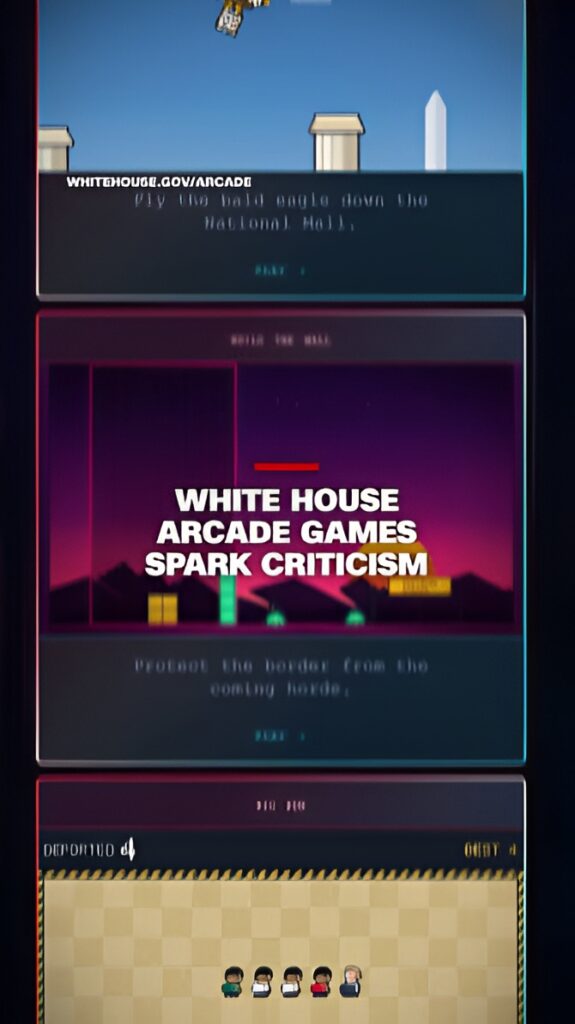
The Trump administration launched a set of five retro-style arcade games on the official White House website this week, repackaging several of the president’s core policy priorities, including mass deportation, as playable, points-scoring entertainment, and immediately drawing sharp criticism from rights groups and even some conservative commentators.
The most contentious of the five games, called “Rio Run,” reworks the mechanics of the classic mobile game Snake. Players control a figure resembling border czar Tom Homan as he “patrols the line” along the Rio Grande, collecting migrants depicted with a range of skin tones to rack up a deportation score. When a player catches a “crosser,” the figure is shown suddenly dressed in an orange jumpsuit and trailing behind the player’s character. A second game, “Build the Wall,” borrows its structure from Tetris, tasking players with stacking bricks to “hold the line” against what the game describes as a “zombie border siege.” Unlike traditional Tetris, when the stack reaches the top of the screen, the game displays the message “BORDER BREACHED” rather than simply ending. After the game’s release, Tetris’s official account publicly distanced itself from the project, posting that the company had not been involved in its creation and that it takes copyright infringement “very seriously,” adding that the brand believes “in the power of connection and bringing people together, not dividing them.”
The remaining three games in the collection steer clear of immigration entirely, covering unrelated administration priorities. One, styled after the arcade classic Tapper, has players sorting food along a conveyor belt and rejecting items that fail to meet “Make America Healthy Again” standards. Another lets users fly a bald eagle along the National Mall, while a third has players filling children’s “Trump accounts,” a administration-branded savings initiative, by catching falling diamonds and cash. The launch was promoted across the administration’s official social media accounts with the slogan “It’s time to level up, patriots,” and follows a broader pattern of the current White House leaning heavily on memes, AI-generated content and internet-native formats to promote its agenda, an approach that has drawn scrutiny before, including over past posts using musicians’ songs without permission in deportation-themed videos, which prompted public criticism and occasional legal threats from artists including Sabrina Carpenter and Olivia Rodrigo.
A White House official defended the launch in a statement, saying the administration is “laser focused on ways to innovate and tell the story of the President’s many accomplishments in a way that resonates with every American,” and describing the arcade as “an effort to further contrast between a culture of fun and winning and the dark socialist vision Democrats have for America.” Kaelan Dorr, a deputy assistant to the president and the White House’s head of digital strategy, described the games on social media more succinctly as “policy you can interact with.” When asked what games could communicate that speeches, formal policy announcements or standard social media posts could not, the official did not directly respond, according to reporting from Forbes.
Also Read: Messi and Argentina Stun England With Late Comeback to Reach World Cup Final
Reaction to the arcade was swift, and notably came from across the political spectrum rather than solely from the administration’s usual critics. Democratic lawmakers were quick to frame the launch as a distraction from economic concerns weighing on ordinary Americans. Connecticut state senator Matt Lesser wrote that “heating oil is near an all-time high” while the administration was building a video game around its border czar, and California Congressman Ted Lieu similarly juxtaposed the arcade’s launch with the fact that average gas prices had climbed to $4.14 a gallon nationally in a social media post reposting the announcement. Texas state representative Jessica González argued the White House had “built video games on a government website before doing anything to solve America’s affordability crisis.”
Advocacy groups working directly with border communities were more pointed still. Adriana Jasso, a program coordinator for a San Diego-based border volunteer organization, said the games showed a “lack of seriousness” from the administration and described the broader approach as dehumanizing, telling reporters that presenting the issue “as if it were a game” obscures the reality that “it is not.” Amerika Garcia Grewal of the Frontera Federation said the project made her “sick,” arguing it trivialized years of real immigration enforcement, adding that the administration had “been playing games with people’s lives for years” and had now made that literal.
Notably, criticism wasn’t confined to the administration’s political opponents. Conservative commentator Meghan McCain reposted a preview clip of the games, calling the project “so gross and distasteful,” a reaction that stood out given her general political alignment with the administration on other issues and underscored just how broadly the launch was received poorly. Online discussion of the arcade also frequently referenced the ongoing US involvement in the Iran conflict and broader cost-of-living concerns, with some users questioning why White House resources were being directed toward arcade game development at a moment when both remain significant points of public anxiety and concern.
This isn’t the first time the administration’s official channels have generated controversy over their handling of immigration-related content. Critics have previously pointed to a pattern of the White House’s social media accounts posting images and content some described as racist or offensive, including a widely criticized depiction of House Minority Leader Hakeem Jeffries and separate content involving former President Obama and his wife. A White House official told CNN last year that the administration views its official website as more than a source of information, describing it explicitly as “a vehicle to push our message” that the administration is willing to “weaponize” for communication purposes, language that has resurfaced in commentary around this week’s arcade launch as evidence of a deliberate and ongoing strategy rather than an isolated misstep.
Despite the backlash, the arcade’s launch has also generated its own pocket of engagement, with some users posting their in-game scores on social media in a more celebratory tone, treating the games as a novelty rather than a point of controversy. Others online responded with dark humor, with one widely shared post drawing a comparison between past presidential communication styles and the current moment, joking that where a previous administration once relied on comedic speeches at press dinners, “the American people get a mass deportation online video arcade” instead. Whether that mixed reception proves durable, or the sustained criticism ultimately forces changes to the site, remains to be seen. As of this week, all five games, including “Rio Run” and “Build the Wall,” remain live and fully playable on the official White House website.